
Communication · August 20, 2026 · Really Hub
What a communication agency does: services, roles and how it works
What a communication agency actually does: the six areas of work, who works inside it, how it differs from an advertising agency and when it is worth hiring one.
A communication agency builds and manages how a company presents itself to the market: it defines positioning and brand identity, produces content, runs social channels and the website, plans advertising campaigns and handles press relations. In practice it gathers into one structure the skills a company would otherwise have to hire one by one.
Put that way, it sounds like they do everything. They do not, and the difference between agencies lies precisely in what they actually do well. This guide covers the six concrete areas of work, the people working inside an agency, how a communication agency differs from an advertising or marketing agency, and when it is not the right structure for you.
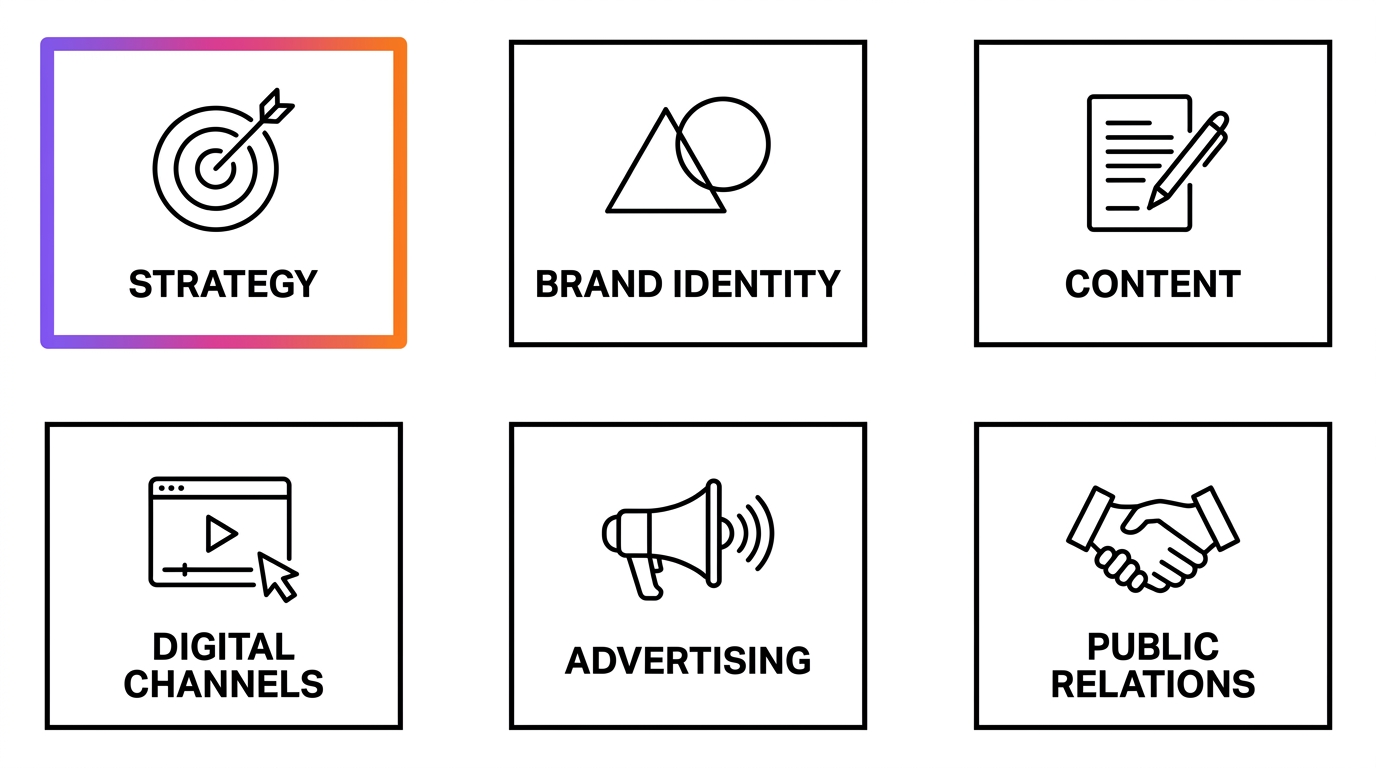
The six areas of work of a communication agency
Strategy and positioning. Market and competitor analysis, definition of the target audience, key messages and the channels worth being on. It is the least visible part and the one that determines whether everything else works.
Brand identity. Logotype, palette, typography, visual system, tone of voice and usage guidelines. The output is not a logo: it is a system that lets different people produce consistent materials for years.
Content. Copy, photography, video, graphics, editorial plans. It is the heaviest cost line in an ongoing engagement, because it is the one that cannot be fully automated.
Digital channels. Social media management, websites and landing pages, email marketing and automation, community management.
Advertising. Media planning and buying, creative production, campaign management and optimisation on Meta, Google, LinkedIn and, where relevant, traditional media.
Public relations. Press office, relationships with journalists and outlets, corporate communication, online reputation and crisis handling.
No agency is strong across all six. When you assess one, ask which of these areas it handles in-house and which it passes to external collaborators: the answer tells you more than any credentials deck.
Communication, advertising or marketing agency: the differences
The three terms get used interchangeably, and they are not the same.
A communication agency works on the long run and on consistency: brand identity, content, relations, continuous presence. The objective is how you are perceived.
An advertising agency works in campaigns: a creative idea, a production, a media plan, a time window. The objective is getting noticed within a defined period.
A marketing agency starts from commercial numbers: acquisition, funnel, conversions, cost per lead. The objective is generating measurable demand.
In practice the overlap is huge and nearly everyone presents as a full-service agency. The way to work out who you are dealing with is not reading their website: it is asking which metrics they use to call a project successful. Whoever answers "awareness", whoever answers "CPL" and whoever answers "press coverage" is telling you what kind of agency they are.
Who works inside a communication agency
Account manager. Your point of contact: collects the brief, coordinates internal work, manages timing and expectations. Does not produce the content.
Strategist. Sets positioning, plan and KPIs. In small agencies the owner covers this role.
Art director and designers. Define the visual language and produce the creative work.
Copywriter. Writes copy, headlines, editorial content, scripts.
Social and community manager. Runs editorial plans, publishing and conversations with the audience.
Paid specialist. Builds and optimises paid campaigns.
Web developer. Builds sites and landing pages, often as an external collaborator.
A useful question before signing: how many of these people will actually work on your project, and for how many hours a month. In small structures two or three roles sit in the same person, which is not a problem in itself, as long as you know it.
How an agency works: the typical process
It starts with brief and discovery: the agency gathers information on the company, sector, competitors and objectives. Strategy follows, defining positioning, messages, priority channels and success indicators. Only then does production of content, creative work or campaigns begin. Daily work runs in cycles: produce, review, publish, measure, adjust.
The signal that marks out a serious agency is mundane but reliable: it shows you the numbers even when they are ugly, and explains what changes next month as a result.
Generalist or specialist agency
If you have no internal marketing manager and need continuous coverage across several fronts, a generalist guarantees coordination and consistency: somebody holds the pieces together for you.
If you already have an internal figure able to direct the work and you need excellence in one precise area, a specialist delivers better results in that discipline.
The third model, increasingly common among companies with marketing maturity, is building an ecosystem of specialists coordinated by an internal figure or an external advisor. It costs less than a generalist and produces a higher technical level, but it requires somebody inside the company to direct it.
How much a communication agency costs
For ongoing work the Italian market moves between 300 and 6,000 euros per month, depending on how many channels you cover, how much content you produce and at what seniority. Closed projects such as a brand identity run from 5,000 to 40,000 euros. Media budget is always a separate line from the agency fee.
The detailed bands, the fee models and how to read a quote are collected in our guide on how much a communication agency costs.
How to measure an agency's work
Measuring the return on communication is possible, provided the metrics are defined before you start. In digital you look at organic traffic, conversion rate and cost per acquisition. On social, reach, engagement and sentiment. In branding, spontaneous and prompted awareness.
What matters is that the KPI set is agreed up front and reported on a fixed cadence. Transparency on data, direct access to analytics platforms and willingness to discuss bad results as clearly as good ones are the most reliable signs of professionalism.
When you do not need a communication agency
When the problem is not a communication problem. If the product has no market or the price is mispositioned, a well-made campaign only speeds up the discovery of the problem.
When you need one vertical skill: in that case you pay for a whole structure to use part of it.
When nobody inside the company has time to give direction. An agency without a counterpart produces generic material, and the blame always lands on the agency.
When the need is concentrated in two or three moments a year: there it is better to work on a project basis, not on a retainer.
The alternative: building the exact team you need
Alongside the agency model there is a third way: selecting the specialists you need directly and composing the team around the project, instead of buying a package that includes resources you are not aligned with. Instead of engaging a structure that handles everything with a fixed team spread across several clients, you choose the people: a strategist, a copywriter with experience in your sector, an art director with the right portfolio.
That is the principle Really Hub is built on: connecting companies with the right professionals, selected one by one, with no management overhead and no fixed structural costs. The full comparison between models is in our guide on outsourcing marketing, and the direct comparison between an agency and a single professional is in agency or freelancer.
Frequently asked questions
What is a communication agency? A structure that brings together strategy, creative, content, media and public relations skills to manage a company's presence in the market, online and offline.
What is a communication agency for? To give you access to multiple skills without hiring them, to bring an outside view on your brand, and to scale resources during peak periods without permanent fixed costs.
What is the difference between a communication agency and an advertising agency? A communication agency works on presence and consistency over time; an advertising agency works in campaigns, with a creative idea and a defined time window.
How long does an agency contract usually last? Ongoing engagements often start at six or twelve months, because below that there is no time to build knowledge of the business. Closed projects last as long as the project.
Do I need an agency if I already have someone internal in marketing? It depends what they can do. If they are a directing figure, it is often better to pair them with external specialists on individual skills rather than a full structure that duplicates their role.
In short
A communication agency offers coordination and breadth of services. A bespoke team of specialists offers focus, real seniority on every deliverable and costs calibrated to actual needs. The choice depends on your internal structure, your objectives and the stage you are at.
If you want to see how a bespoke team comes together, look at how Really Hub works or the marketing services you can activate.
- #agenzia di comunicazione
- #servizi agenzia comunicazione
- #figure professionali agenzia
- #brand
- #strategia