
Marketing · September 15, 2026 · Really Hub
How to choose a marketing agency: criteria and questions
The five criteria for choosing a marketing agency, the questions to ask at the first meeting, the warning signs and when an agency is the wrong call.
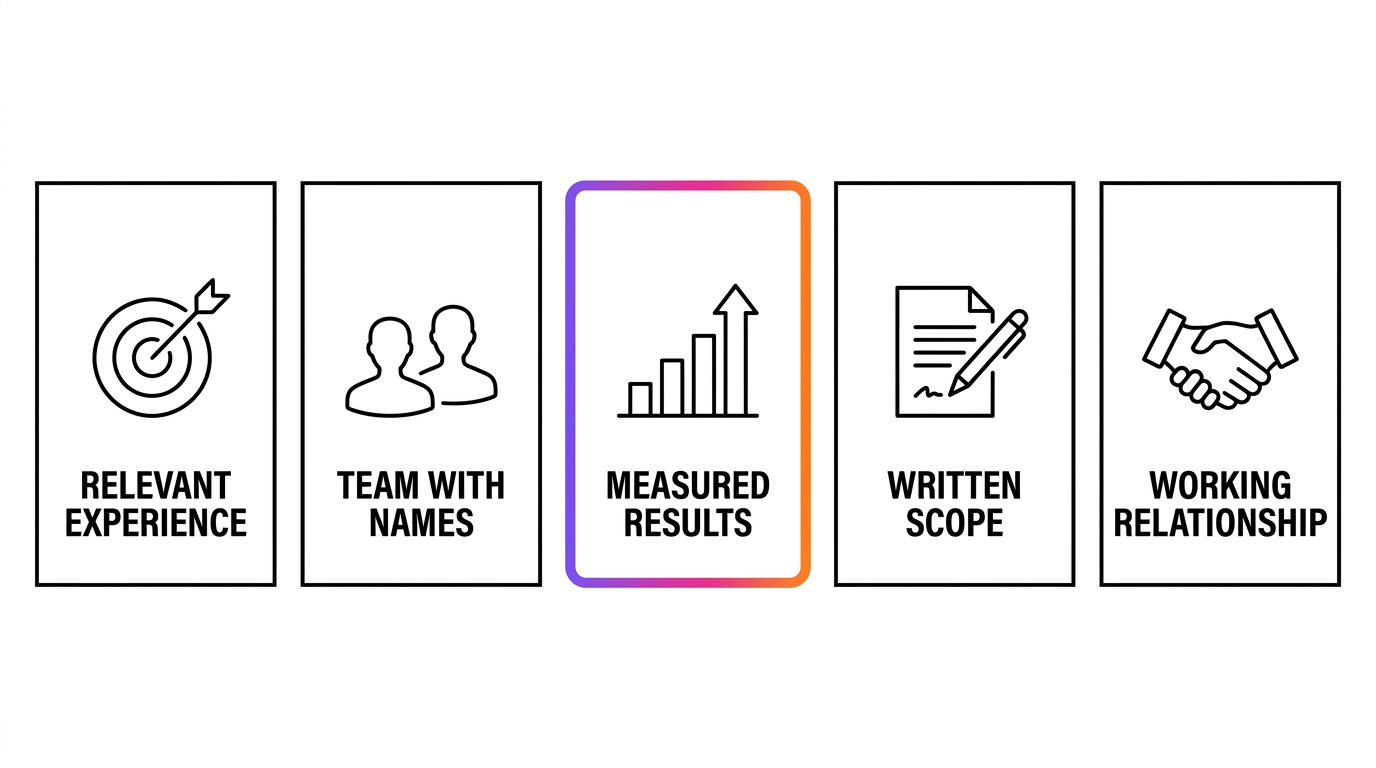
Choosing a marketing agency comes down to five checks: the agency has already solved problems like yours, it tells you by name who will work on the project, it shows measured results rather than just creative work, it puts scope and costs in writing, and you can actually work with the people you meet. Everything else, from awards to the agency's follower count, matters far less than these five points.
Before the criteria, though, comes something most companies skip: knowing what you want to achieve. An agency chosen without a clear goal produces activity, not results. This guide covers how to define the goal, the five evaluation criteria, the questions to ask at the first meeting, the warning signs, how to run a selection between several agencies, and the cases where an agency is the wrong answer.
Before looking for an agency: the goal
"Doing more marketing" is not a goal. Increasing contact requests by 30% in six months, entering a new market, turning the website from a source of visits into a source of leads: those are goals. Before contacting any agency, write half a page on the business result you want, the time horizon, the budget and who in the company will own the project.
That half page is your brief. It helps you compare proposals on the same basis, and it helps the agency understand whether the work fits. A vague brief produces vague proposals, and vague proposals can only be compared on price, which is the worst way to choose.
The five criteria for evaluating a marketing agency
Relevant experience. The agency does not need to have worked in your industry; it needs to have solved your type of problem: launching a product, generating B2B leads, building a brand from scratch. Ask for a case similar to yours and have them tell you what worked and what did not. An agency with only successes to share has learned nothing, or is not telling you.
A team with names. The people who pitch are rarely the people who will work on your project. Ask for the names, roles and seniority of those who will follow the work day to day, and how many other clients they handle at the same time. "A dedicated team" without names means nothing.
Measured results. Read the portfolio with one criterion only: for each project, what were the goals and what was achieved. Be wary of portfolios full of creative awards and empty of business numbers. A beautiful campaign that produced nothing measurable is not a good sign, it is a cost.
Written scope. A serious proposal states what is included, what is not, the timeline, the price and what happens if the scope grows. If any of these is missing, ask before signing. For price bands to orient yourself, see our guide on how much a communication agency costs.
Working relationship. You will work together for months, sometimes years. If answers already arrive late during the proposal stage, questions about your business are few and the tone is pure sales, it will not improve after signing.
Questions to ask at the first meeting
The first meeting says a lot about how an agency works, provided you ask the right questions. How would you define success for this collaboration? Which KPIs do you track by default on projects like mine? Who exactly will be the team on my account? How do you handle revisions and feedback? How often, and in what format, do you report results? What happens if it is not working after three months?
Useful answers are concrete: percentages, tools, names, processes. Vague, buzzword-heavy or overly commercial answers are a signal you should not ignore. One more question worth asking: what do you need from us to do good work? An agency that asks nothing of you has not understood that marketing is a two-way effort.
Specialised or full service
Full-service agencies cover the whole chain: strategy, creative, content, media, performance. Specialised agencies do one thing very well: SEO, advertising, social, PR, brand. The former give you coordination and consistency, but rarely excel at everything. The latter give you depth, but if you need three disciplines you have to coordinate three suppliers.
The choice depends on who you have in-house. If nobody can act as director, a full-service agency is the better fit, or alternatively an external marketing manager coordinating individual specialists. If you have someone internally who can lead several suppliers, specialised agencies deliver better results in each area. We also covered this comparison in agency or freelancer.
The warning signs
Some behaviours during selection anticipate the problems you will see in daily work. The agency presents a proposal without having asked in-depth questions about your business: it recycled a deck. It guarantees precise results on organic channels such as SEO in a short time: that is not possible, and whoever promises it knows. It does not specify who works on your account. It refuses to sign a confidentiality agreement before receiving sensitive information. It reports on activities carried out, not on business impact.
Another, less obvious sign: long lock-in contracts. Twelve mandatory months with an exit penalty protect the agency from an unhappy client, not you. Those who do good work do not need to chain you down: a thirty-day notice period is a normal condition for a healthy collaboration.
How to run a selection between several agencies
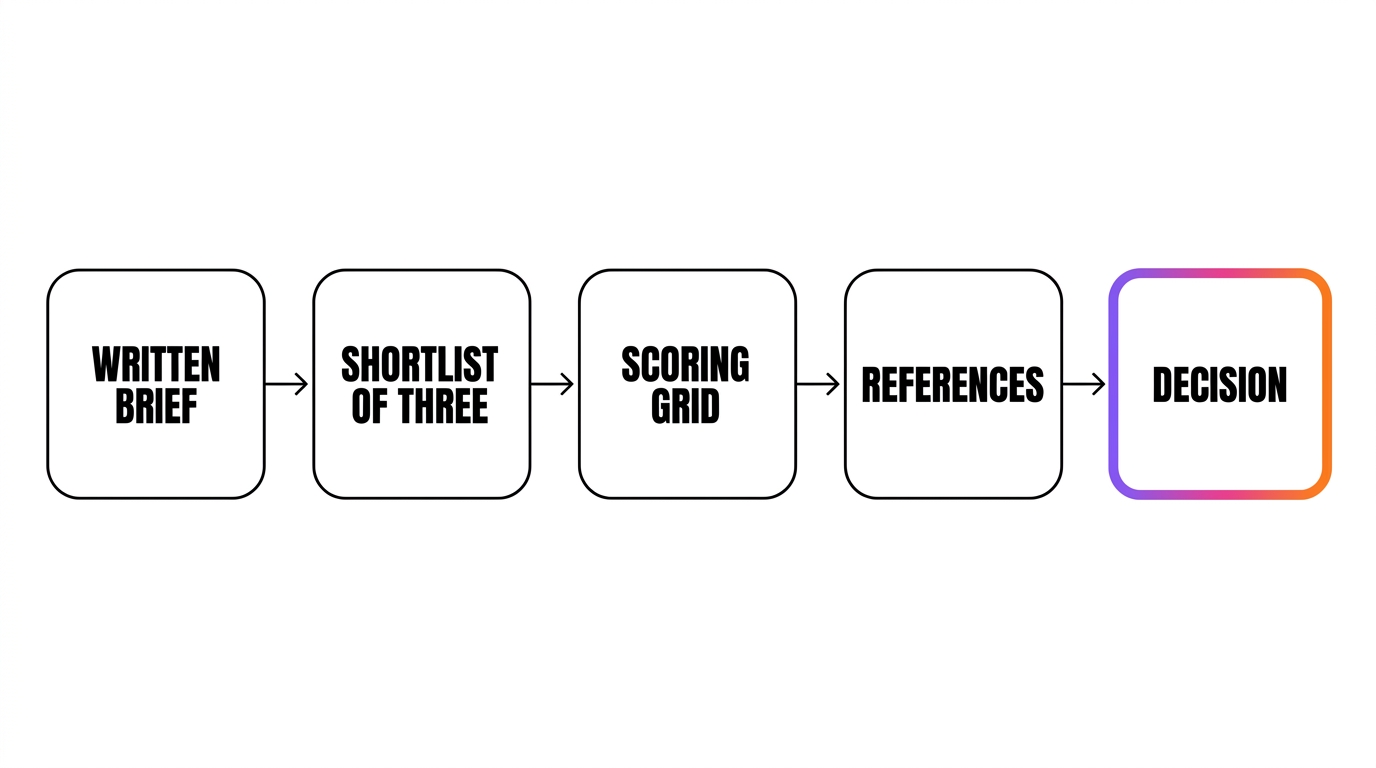
If you are evaluating several agencies, a structured selection reduces the risk of choosing on rapport or slide quality. The process that works has five steps. One identical written brief for all. A shortlist of three agencies at most: more and you cannot evaluate them properly, fewer and you have no comparison. A scoring grid with criteria and weights decided before seeing the proposals. At least two references per finalist, contacted with questions about daily work and not only final results. Then the decision.
The right agency is not the one with the most brilliant pitch. It is the one you can build a transparent relationship with, around shared goals, and that brings up the numbers before you even ask.
When a marketing agency is the wrong choice
There are situations where the agency is the most expensive model for the same result. When you need a single, very vertical skill: you pay for a whole structure to use one piece of it. When the need is not continuous: a retainer makes you pay twelve months for two months of real work. When coordination with the agency generates more meetings than results. When the budget cannot support an agency's structure, but the skills you need are still senior.
In those cases it makes more sense to select the right people directly, an SEO specialist, a copywriter, an art director, a media buyer, and build the exact team for the project, with someone coordinating it. That is how Really Hub works: the team is assembled for the goal and coordinated by whoever built it, and you work with the professionals, not with an account manager. The four models, with the costs and limits of each, are in our guide on outsourcing your marketing.
The most common mistakes
Choosing on the lowest price, which almost always means juniors presented as seniors. Being guided by the pitch instead of the cases. Not asking who really works on the project. Signing without a written scope. Keeping the agency in the dark about business numbers: external marketing only works if the people doing it know your margins, customers and real goals. And the mistake upstream of all the others: looking for an agency before having a goal.
Frequently asked questions about choosing a marketing agency
How much does a marketing agency cost per month? Between 300 and 1,000 euros for a minimal presence on one or two channels, between 1,000 and 3,000 for structured management, between 3,000 and 6,000 for a full team with content and advertising. Media budget is always separate. The breakdown by service is in our guide on agency costs.
Which is the best marketing agency in Italy? There is no absolute answer. There is the right one for your goal, your budget and your internal structure. Online rankings are almost always paid or based on creative awards, not business results: use them at most to build an initial list, then apply the five criteria.
Is a local agency better than a remote one? For most marketing services distance no longer matters: strategy, content, campaigns and SEO are managed remotely without losing anything. Proximity only helps when the work requires frequent physical presence, such as video production or events.
How long does agency selection take? With a ready brief and a shortlist of three, between four and six weeks from first contact to signature. If it takes much longer, the problem is usually upstream: the goal is unclear and the proposals are not comparable.
What should the contract contain? Scope of activities, team with names and roles, timeline with dated deliverables, financial terms and how extras are handled, KPIs and reporting frequency, exit conditions. If any of these is missing, ask before signing.
In short
Choosing a marketing agency is a process, not a stroke of luck: start from the goal, apply the five criteria, ask the right questions, watch for the warning signs and ask yourself whether the agency model is really what you need. What an agency actually does, area by area, is in our guide on what a communication agency does.
If instead you want a team built around your goal, without an agency's structure and without lock-in, see how Really Hub works or the marketing services you can activate.
- #come scegliere un'agenzia di marketing
- #agenzia di marketing
- #selezione agenzia
- #gara agenzia
- #partner marketing